
Peptides
7 Best Peptide Companies: How to Get Legal Peptides Online
7 Best Peptide Companies: How to Get Legal Peptides Online
Last Updated
Table of contents
Table of contents
Choosing the best peptide company in 2026 means cutting through a fast-changing legal picture. A short list of peptides is legally available to buy online today through licensed telehealth companies working with 503A and 503B compounding pharmacies, while a larger list is moving through a formal FDA review that will decide whether more come back.
This is a data-first ranking of the best peptide companies, plus where to buy peptides online legally, current as of 2026. Below you will find what is genuinely legal to get today, what is under review and when, how the top providers compare on coverage and price, and how to tell a legitimate company from a marginal one. For the science on individual compounds, see our evidence-based peptide guide.
The 2026 peptide landscape · the numbers
What makes the best peptide company in 2026
In a category where the legal list is short and changing, the best peptide company is not the one with the longest menu, it is the one that prescribes responsibly and tells you the truth about what is legal. We scored each company on five things, weighted toward clinical depth and transparency: how much of the genuinely legal list it offers and how ready it is for the peptides under review, who actually writes and monitors the prescription, whether pricing and lab costs are published clearly, how widely it operates, and its track record and pharmacy partnerships.
One filter matters more than any feature: a peptide is only as good as the data behind the dose. The companies that rank highest pair a prescription with real bloodwork, not a checkout cart. Appropriate laboratory monitoring should be individualized according to the peptide prescribed, the patient's medical history, and current clinical practice guidelines, so what gets tested will not look identical for every compound. That is the lens for everything below.
How the rules changed in three years
The regulatory saga runs from the first restriction in 2023 to a review still in progress. The key thing to understand: removal from the restricted list is not the same as being legal to compound. A favorable committee vote still has to be followed by FDA rulemaking, which can take well over a year.
How we got here
The timeline, start to now
What is legal now, and what is under review
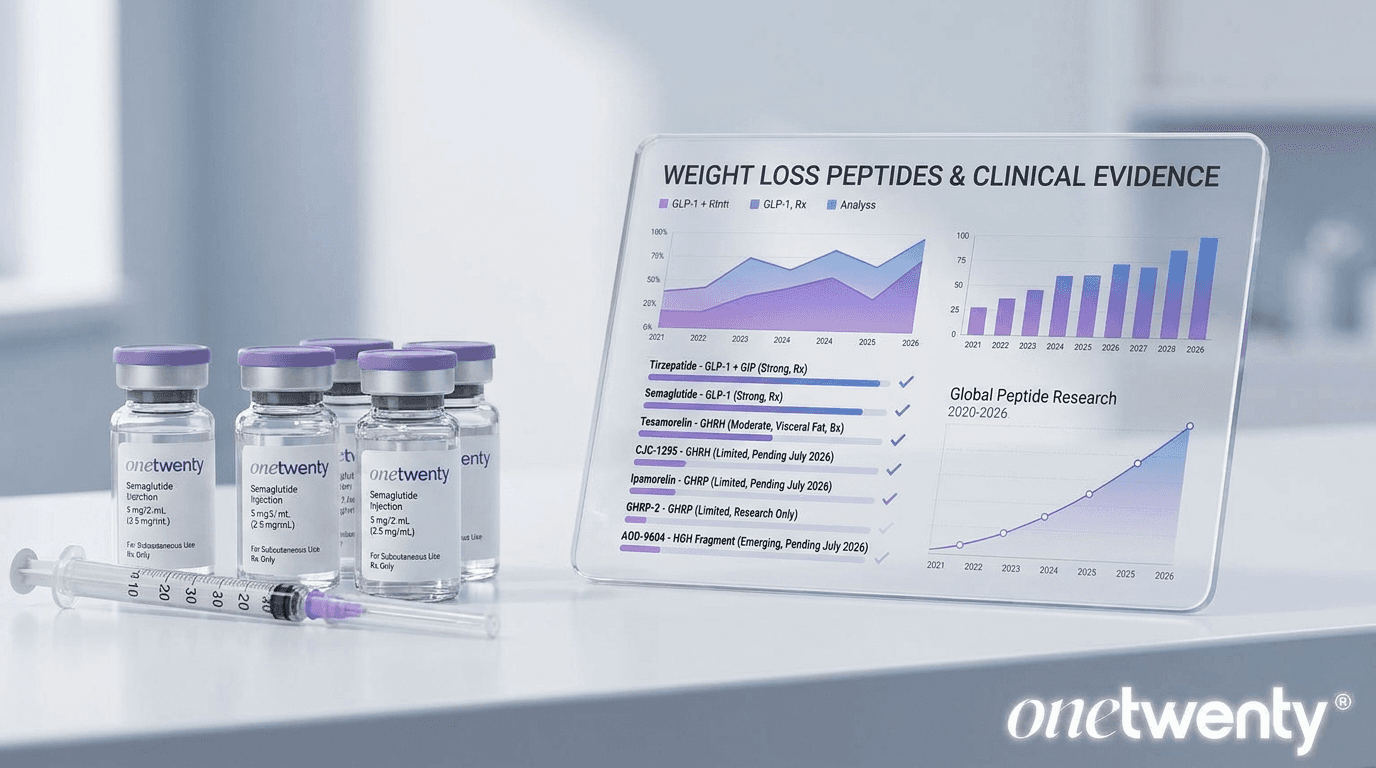
Only a limited number of peptide therapies are currently available through licensed prescribing pathways. Other compounds discussed here, such as NAD+ and glutathione, are not peptides at all, but are non-peptide therapies that some companies also offer. A larger group is on the FDA review track. On July 23 to 24, 2026, the advisory committee voted to recommend four of them, BPC-157, KPV, TB-500, and MOTS-C, but that vote is advisory only, and none can be dispensed until the FDA completes rulemaking. Any company claiming it can sell you BPC-157 or TB-500 right now is cutting corners.
Legal to get today
Under FDA review
FDA Pharmacy Compounding Advisory Committee meeting, July 23 to 24, 2026 (docket FDA-2025-N-6895); FDA 503A bulk substances Category updates, April 2026.
The best peptide companies, ranked
The top peptide companies in the USA, scored out of ten on formulary relevance, clinical depth, price and transparency, accessibility, and reputation. A company can be excellent overall and still land mid-pack if its peptide menu is thin, because this ranks peptide therapy specifically, not general hormone care.
One thing to be clear about before the table: these rankings reflect our assessment of available services, transparency, and scope of care. They are editorial. They should not be interpreted as evidence that one provider produces superior clinical outcomes, because no head-to-head outcome data exists to support that kind of claim.
| Rank | Company | Score | Coverage | Pricing | Best for |
|---|---|---|---|---|---|
| 1 | OneTwenty Go here | 9.5 | National telehealth | $499/yr ($749 NY/NJ) | Data-driven care |
| 2 | Celia RX Shop | 9.1 | National telehealth + pharmacy | $179 to $899 per product | Compounded Rx peptides by mail |
| 3 | Marek Health | 8.7 | National | $166+/mo plus labs | Optimization |
| 4 | Victory Select | 8.0 | Regional (TX) | Quote on consult | Rare peptides |
| 5 | Maximus | 7.9 | All 50 states | $199/mo, labs in | Sermorelin first-timers |
| 6 | TRT Nation | 7.6 | National | $99/mo flat | TRT plus BPC-157 |
| 7 | Blue Sky MD | 6.8 | North Carolina | Quote on consult | NC residents |
Where to buy peptides online, legally and safely
If you are searching for where to buy peptides online, the honest answer is that there is no legitimate over-the-counter store. Legal peptides online run through a prescription: you work with one of the licensed telehealth companies above, a clinician writes the script, and a 503A or 503B compounding pharmacy fills and ships it. The legal-now peptides, Sermorelin, PT-141, and Gonadorelin, can be bought online this way today, as can non-peptide therapies like NAD+ and glutathione that companies commonly offer alongside them. The peptides under FDA review cannot be sold yet, no matter what a site claims.
So the best place to buy peptides online is the company whose prescribing and pharmacy partners you trust, not the cheapest listing on a research-chemical site. Anything sold online "for research use only," with no prescription step and no named pharmacy, is the gray market: unregulated, often mislabeled, and a legal and safety risk. Use the vetting checklist below before you buy from any peptides-online vendor.
The companies, in depth
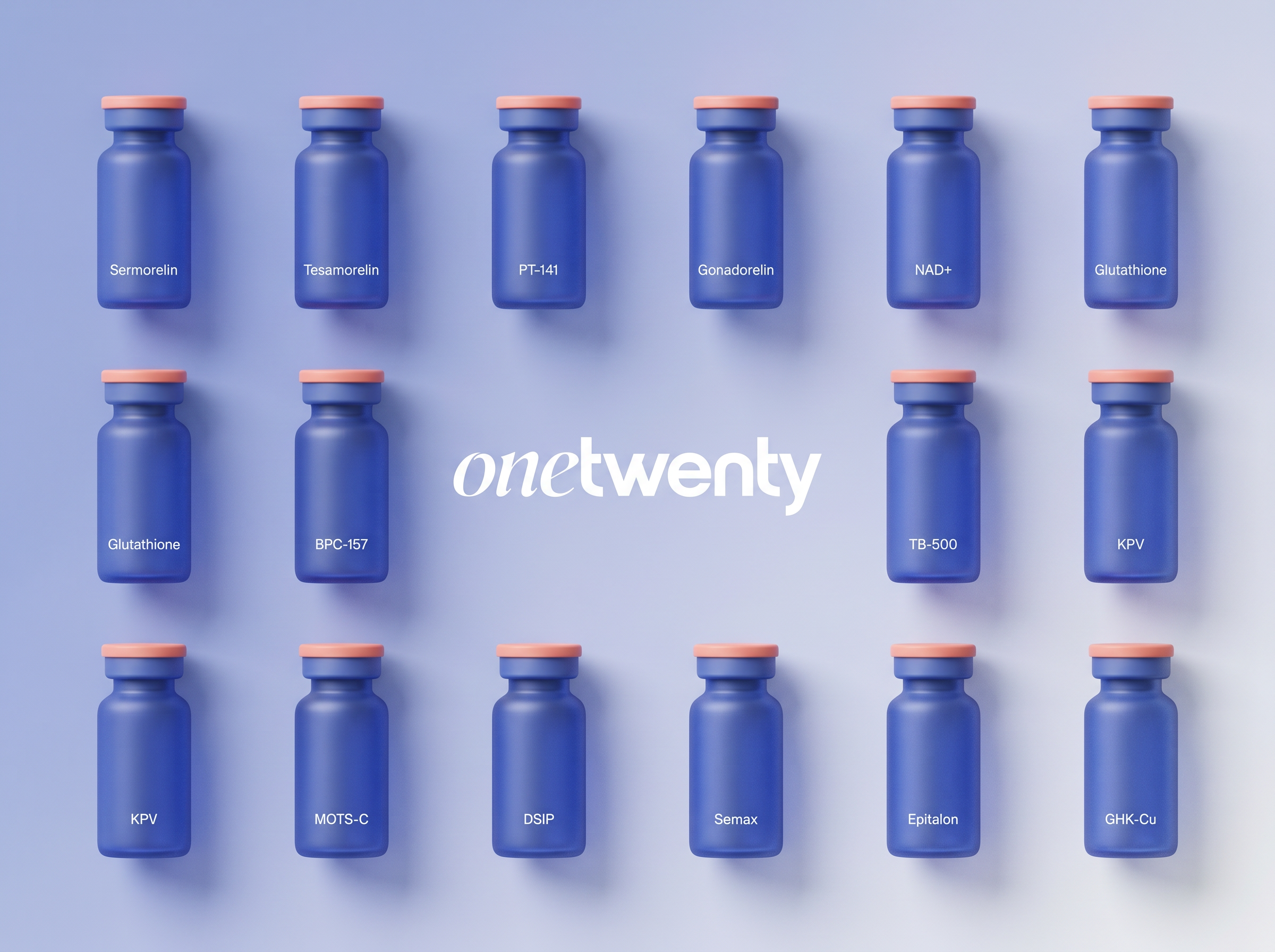
1. OneTwenty
9.5Best overall · data-driven care
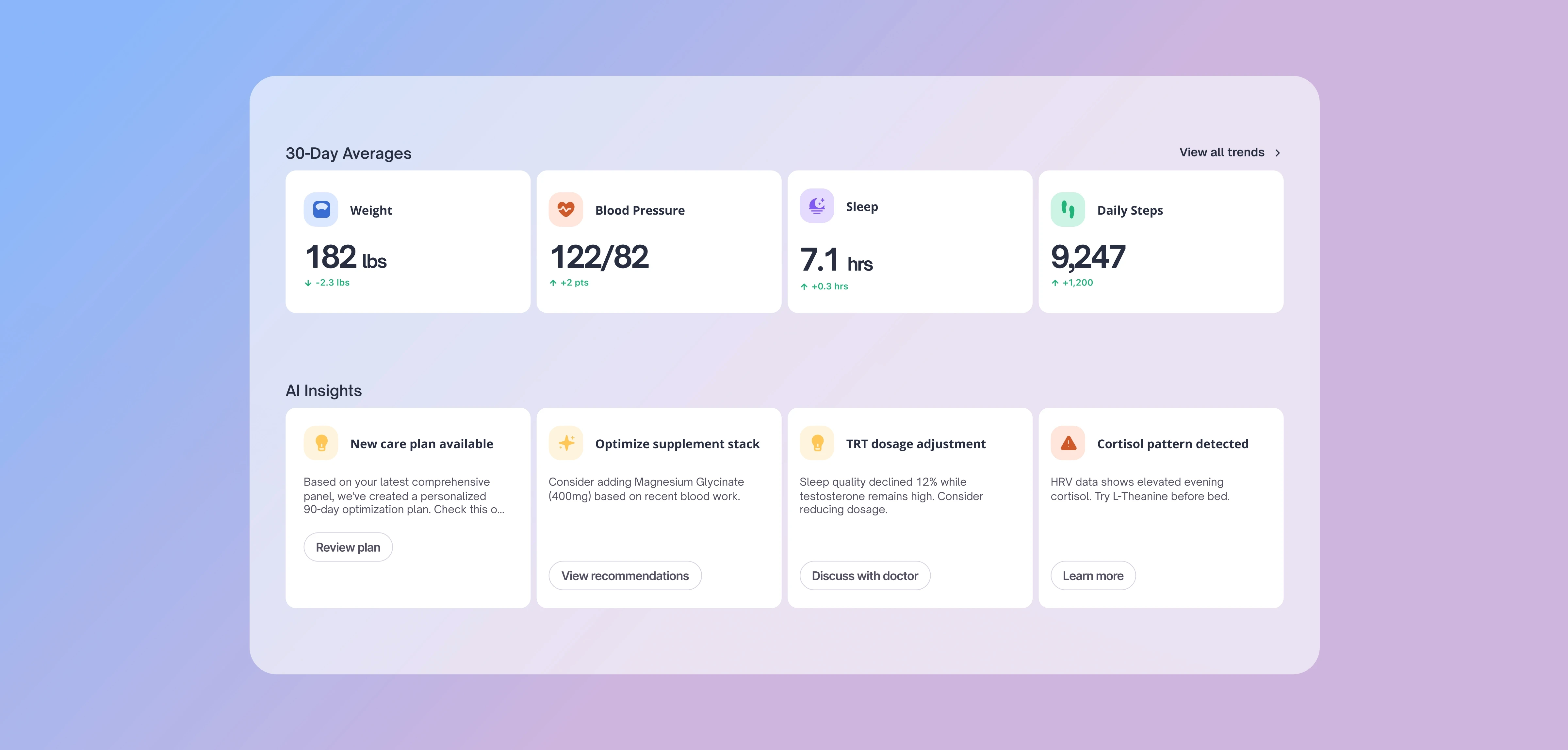
Every other company on this list sells you the peptide. OneTwenty sells you the full picture the peptide should be prescribed from. Membership is built on quarterly comprehensive blood panels, continuous data from your wearable, scale, and blood-pressure cuff, an AI coaching layer that reads all of it, and telehealth visits that turn those numbers into a protocol.
OneTwenty offers a legal peptide formulary plus bioidentical HRT, and adds the rest as they clear the FDA process. The model is transparent: $499 a year buys the membership, the testing, and the care, and peptide prescriptions are an add-on billed separately, not a bundled base fee. Because the prescription follows the data, dose titration is built into the model.
$499/yr covers testing and care, $749/yr in New York and New Jersey · peptides billed separately · national telehealth
What OneTwenty offers today
Glutathione, NAD+, sermorelin, and PT-141 are available now, and we add more peptides as they clear the FDA process. Semaglutide and tirzepatide are GLP-1 medicines, closely related to peptides, offered with the same clinician monitoring. Tap any option to see its medication page.
Care built from your data, not a checkout cart.
OneTwenty pairs comprehensive testing and quarterly panels with bioidentical HRT and the legal peptide formulary, with the rest added as the FDA process clears them. Testing cadence is set with your clinician, based on the therapy and your history.
Go Here →$499/yr membership for testing and care, $749/yr in New York and New Jersey · peptides billed separately
2. Celia RX
9.1Best for compounded Rx peptides by mail
Celia RX is a telehealth and compounding-pharmacy service that ships prescription-grade compounded products after a paid onboarding consultation. It is LegitScript-certified and operates under HIPAA privacy practices, which is what separates it from the research-use-only sellers this guide warns against. Its catalog centers on the legal-now core, Sermorelin, PT-141, NAD+, and glutathione, alongside compounded GLP-1s (semaglutide and tirzepatide) and hair and skin peptides, in injectable, nasal, and oral formats.
FDA status: Celia RX does not sell the peptides currently under FDA review, such as BPC-157 or TB-500, so those are not part of its catalog. Its compounded GLP-1 products sit under evolving FDA compounding rules that can change with drug-shortage status, so confirm current legal availability directly before ordering.
Affiliate disclosure: OneTwenty has an affiliate relationship with Celia RX and may earn a commission on purchases made through the link above. This does not affect its placement in this ranking.
Use promo code 10off for 10% off at Celia RX.
Pricing is per product rather than a flat membership, so a full protocol adds up quickly, and it is a pharmacy-first service rather than the data-driven, test-first model OneTwenty is built on.
3. Marek Health
8.7Best for optimization
Built its reputation on data. Standard panels test sixty-plus biomarkers, a level deeper than almost any competitor, with a preventative rather than replacement-only philosophy. Strong on the legal-now core and positioned for the marquee reviewed peptides, with a functional-medicine lens that catches issues hormone-only companies miss.
The most expensive option fully loaded. Base is $166-plus a month, but labs add $450 to $1,700 a year, so the all-in can exceed even a concierge company. Can feel overbuilt for simple needs.
4. Victory Select
8.0Best for specialty peptides
An online pharmacy and telehealth company based in Texas with one of the broadest specialty lists in the regional category, positioned on harder-to-find reviewed peptides like KPV and MOTS-C alongside the standard recovery and growth hormone compounds. A natural home for the reviewed peptides if they clear.
Regional, so verify state coverage first. Thinner on the legal-now core (no NAD+ or glutathione), and most protocols require a consult to get a quote.
5. Maximus
7.9Best for sermorelin first-timers
One of the best mainstream optimization companies in the country: all fifty states, $199 a month flat with labs included, physician-led care, at-home lab kits. But this is a peptide-specific ranking, and on peptides Maximus is sermorelin and nothing else, which is why a company this strong sits mid-pack. For sermorelin with the easiest onboarding, it is excellent.
Sermorelin is the entire peptide menu. No recovery, longevity, or reviewed peptides on the roadmap, so you will outgrow it fast if you want anything more.
6. TRT Nation
7.6Best for TRT plus one recovery peptide
Built around $99 a month flat-rate testosterone replacement with no contracts and unlimited consultations. The peptide story is thin: gonadorelin as TRT support now, and BPC-157 lined up for if it clears review. A great TRT product, not a peptide company.
Not a peptide-forward company. If peptides are your primary goal, look at OneTwenty, Celia RX, or Marek instead.
7. Blue Sky MD
6.8Best for North Carolina residents
A North Carolina bioidentical hormone and peptide company with a telehealth arm for existing patients. The hybrid model, combining in-person visits with telehealth follow-ups, is rare in a space that runs almost entirely over video.
Regional only, so not a fit outside North Carolina and nearby states. Narrow on the legal-now core, and pricing is not published upfront.
How to vet a peptide company
Five things separate a legitimate telehealth company from a marginal one. On testing cadence, note that there is no universal evidence-based schedule: the frequency of laboratory monitoring should be individualized according to the therapy being used, underlying medical conditions, treatment response, and current clinical guidelines.
Clear red flags
Selling peptides under review as available now, no prescription step, crypto-only payment, unmarked vials, "starting at" pricing that hides the clinical-dose cost, or pressure to buy bundles before your first clinician call.
Best peptide companies FAQ
What is the best peptide company in 2026?
For data-driven care, OneTwenty ranks first because it builds the prescription from quarterly comprehensive bloodwork and continuous device data rather than selling a peptide off a menu. Marek Health is among the strongest established peptide-and-hormone practices, and Celia RX is a LegitScript-certified option for compounded prescription peptides shipped by mail. The best company for you depends on whether you want depth of testing, the broadest menu, or the lowest price.
Where can I buy peptides online?
Legally, only through a licensed telehealth company and a 503A or 503B compounding pharmacy, with a prescription. The companies ranked above sell the currently legal peptides (Sermorelin, PT-141, Gonadorelin) online today, along with non-peptide therapies such as NAD+ and glutathione. Sites selling BPC-157 or TB-500 online "for research" with no prescription are gray-market and not legitimate.
What are the best peptide companies?
OneTwenty leads for data-driven care, Marek Health for depth and breadth, Celia RX for compounded prescription peptides by mail, and TRT Nation for the lowest price on TRT plus a recovery peptide. The right one depends on whether you prioritize testing depth, menu breadth, or price.
Are online peptide companies legit?
The legitimate ones use a named, licensed prescriber and a disclosed compounding pharmacy, and only sell currently legal peptides. The category also has gray-market sellers that are neither, so use the vetting checklist above before buying online.
Are online peptide companies legit and legal?
The legitimate ones are. A real company uses a licensed prescriber and a disclosed 503A or 503B compounding pharmacy, and only dispenses peptides that are currently legal. The category also has gray-market sellers that are neither, so the vetting checklist above matters.
Can you get BPC-157 or TB-500 from a company right now?
Not legally through compounding, at least not yet. Both were removed from the FDA Category 2 list in April 2026, and on July 23 to 24, 2026 the advisory committee voted to recommend them for the 503A list. That vote is advisory only, so they still cannot be compounded until the FDA completes rulemaking, which takes time. Any company offering them today is cutting corners.
How much does a peptide company cost?
It ranges widely. Flat memberships run from about $99 a month (TRT-first companies) to $200 to $650 a month for comprehensive concierge care, plus lab costs that many companies bill separately. OneTwenty uses a $499 a year membership for testing and care, with peptides billed separately.
Do peptide companies require bloodwork?
The good ones do. Baseline labs (with IGF-1 for growth hormone peptides) and periodic re-checks are how a clinician doses safely and tracks whether a protocol is working. A company that skips bloodwork is a red flag.
What is the best company for TRT and peptides together?
If testosterone is the priority with a recovery peptide alongside, TRT Nation is the cheapest serious option and Marek among the most comprehensive. If you want hormones and peptides run off one set of quarterly data, OneTwenty is built for exactly that.
How to get started
Figure out what you are solving for first, since recovery, growth hormone support, longevity, and sexual health each point toward a different company. Bring recent bloodwork if you have it, because results from the last six months can save a cycle. Start with one company, not two, since running TRT from one provider and wellness peptides from another creates fragmented care and dangerous prescribing conflicts. And budget for ongoing monitoring, because most companies do not include labs in the headline fee. A comprehensive longevity panel is the right baseline to start from.
Sources & references
- FDA, Pharmacy Compounding Advisory Committee meeting, July 23 to 24, 2026; agenda of seven peptides for 503A review (docket FDA-2025-N-6895). fda.gov
- FDA 503A bulk drug substances list updates, April 2026 (12 peptides removed from Category 2 for evaluation).
- Hyman, Phelps & McNamara, FDA Law Blog, analysis of the 2026 peptide compounding actions. thefdalawblog.com
- PCAC reviews of CJC-1295 and Ipamorelin (declined, 2024); remain restricted under 503A.
- Company pricing and formulary details per each provider's site, 2026 (OneTwenty, Celia RX, Marek Health, Victory Select, Maximus, TRT Nation, Blue Sky MD).
This guide is for general education and is not medical advice. Legal status, pricing, and company formularies change frequently; confirm current details before acting. Discuss any peptide with a qualified physician.
Choosing the best peptide company in 2026 means cutting through a fast-changing legal picture. A short list of peptides is legally available to buy online today through licensed telehealth companies working with 503A and 503B compounding pharmacies, while a larger list is moving through a formal FDA review that will decide whether more come back.
This is a data-first ranking of the best peptide companies, plus where to buy peptides online legally, current as of 2026. Below you will find what is genuinely legal to get today, what is under review and when, how the top providers compare on coverage and price, and how to tell a legitimate company from a marginal one. For the science on individual compounds, see our evidence-based peptide guide.
The 2026 peptide landscape · the numbers
What makes the best peptide company in 2026
In a category where the legal list is short and changing, the best peptide company is not the one with the longest menu, it is the one that prescribes responsibly and tells you the truth about what is legal. We scored each company on five things, weighted toward clinical depth and transparency: how much of the genuinely legal list it offers and how ready it is for the peptides under review, who actually writes and monitors the prescription, whether pricing and lab costs are published clearly, how widely it operates, and its track record and pharmacy partnerships.
One filter matters more than any feature: a peptide is only as good as the data behind the dose. The companies that rank highest pair a prescription with real bloodwork, not a checkout cart. Appropriate laboratory monitoring should be individualized according to the peptide prescribed, the patient's medical history, and current clinical practice guidelines, so what gets tested will not look identical for every compound. That is the lens for everything below.
How the rules changed in three years
The regulatory saga runs from the first restriction in 2023 to a review still in progress. The key thing to understand: removal from the restricted list is not the same as being legal to compound. A favorable committee vote still has to be followed by FDA rulemaking, which can take well over a year.
How we got here
The timeline, start to now
What is legal now, and what is under review
Only a limited number of peptide therapies are currently available through licensed prescribing pathways. Other compounds discussed here, such as NAD+ and glutathione, are not peptides at all, but are non-peptide therapies that some companies also offer. A larger group is on the FDA review track. On July 23 to 24, 2026, the advisory committee voted to recommend four of them, BPC-157, KPV, TB-500, and MOTS-C, but that vote is advisory only, and none can be dispensed until the FDA completes rulemaking. Any company claiming it can sell you BPC-157 or TB-500 right now is cutting corners.
Legal to get today
Under FDA review
FDA Pharmacy Compounding Advisory Committee meeting, July 23 to 24, 2026 (docket FDA-2025-N-6895); FDA 503A bulk substances Category updates, April 2026.
The best peptide companies, ranked
The top peptide companies in the USA, scored out of ten on formulary relevance, clinical depth, price and transparency, accessibility, and reputation. A company can be excellent overall and still land mid-pack if its peptide menu is thin, because this ranks peptide therapy specifically, not general hormone care.
One thing to be clear about before the table: these rankings reflect our assessment of available services, transparency, and scope of care. They are editorial. They should not be interpreted as evidence that one provider produces superior clinical outcomes, because no head-to-head outcome data exists to support that kind of claim.
| Rank | Company | Score | Coverage | Pricing | Best for |
|---|---|---|---|---|---|
| 1 | OneTwenty Go here | 9.5 | National telehealth | $499/yr ($749 NY/NJ) | Data-driven care |
| 2 | Celia RX Shop | 9.1 | National telehealth + pharmacy | $179 to $899 per product | Compounded Rx peptides by mail |
| 3 | Marek Health | 8.7 | National | $166+/mo plus labs | Optimization |
| 4 | Victory Select | 8.0 | Regional (TX) | Quote on consult | Rare peptides |
| 5 | Maximus | 7.9 | All 50 states | $199/mo, labs in | Sermorelin first-timers |
| 6 | TRT Nation | 7.6 | National | $99/mo flat | TRT plus BPC-157 |
| 7 | Blue Sky MD | 6.8 | North Carolina | Quote on consult | NC residents |
Where to buy peptides online, legally and safely
If you are searching for where to buy peptides online, the honest answer is that there is no legitimate over-the-counter store. Legal peptides online run through a prescription: you work with one of the licensed telehealth companies above, a clinician writes the script, and a 503A or 503B compounding pharmacy fills and ships it. The legal-now peptides, Sermorelin, PT-141, and Gonadorelin, can be bought online this way today, as can non-peptide therapies like NAD+ and glutathione that companies commonly offer alongside them. The peptides under FDA review cannot be sold yet, no matter what a site claims.
So the best place to buy peptides online is the company whose prescribing and pharmacy partners you trust, not the cheapest listing on a research-chemical site. Anything sold online "for research use only," with no prescription step and no named pharmacy, is the gray market: unregulated, often mislabeled, and a legal and safety risk. Use the vetting checklist below before you buy from any peptides-online vendor.
The companies, in depth
1. OneTwenty
9.5Best overall · data-driven care
Every other company on this list sells you the peptide. OneTwenty sells you the full picture the peptide should be prescribed from. Membership is built on quarterly comprehensive blood panels, continuous data from your wearable, scale, and blood-pressure cuff, an AI coaching layer that reads all of it, and telehealth visits that turn those numbers into a protocol.
OneTwenty offers a legal peptide formulary plus bioidentical HRT, and adds the rest as they clear the FDA process. The model is transparent: $499 a year buys the membership, the testing, and the care, and peptide prescriptions are an add-on billed separately, not a bundled base fee. Because the prescription follows the data, dose titration is built into the model.
$499/yr covers testing and care, $749/yr in New York and New Jersey · peptides billed separately · national telehealth
What OneTwenty offers today
Glutathione, NAD+, sermorelin, and PT-141 are available now, and we add more peptides as they clear the FDA process. Semaglutide and tirzepatide are GLP-1 medicines, closely related to peptides, offered with the same clinician monitoring. Tap any option to see its medication page.
Care built from your data, not a checkout cart.
OneTwenty pairs comprehensive testing and quarterly panels with bioidentical HRT and the legal peptide formulary, with the rest added as the FDA process clears them. Testing cadence is set with your clinician, based on the therapy and your history.
Go Here →$499/yr membership for testing and care, $749/yr in New York and New Jersey · peptides billed separately
2. Celia RX
9.1Best for compounded Rx peptides by mail
Celia RX is a telehealth and compounding-pharmacy service that ships prescription-grade compounded products after a paid onboarding consultation. It is LegitScript-certified and operates under HIPAA privacy practices, which is what separates it from the research-use-only sellers this guide warns against. Its catalog centers on the legal-now core, Sermorelin, PT-141, NAD+, and glutathione, alongside compounded GLP-1s (semaglutide and tirzepatide) and hair and skin peptides, in injectable, nasal, and oral formats.
FDA status: Celia RX does not sell the peptides currently under FDA review, such as BPC-157 or TB-500, so those are not part of its catalog. Its compounded GLP-1 products sit under evolving FDA compounding rules that can change with drug-shortage status, so confirm current legal availability directly before ordering.
Affiliate disclosure: OneTwenty has an affiliate relationship with Celia RX and may earn a commission on purchases made through the link above. This does not affect its placement in this ranking.
Use promo code 10off for 10% off at Celia RX.
Pricing is per product rather than a flat membership, so a full protocol adds up quickly, and it is a pharmacy-first service rather than the data-driven, test-first model OneTwenty is built on.
3. Marek Health
8.7Best for optimization
Built its reputation on data. Standard panels test sixty-plus biomarkers, a level deeper than almost any competitor, with a preventative rather than replacement-only philosophy. Strong on the legal-now core and positioned for the marquee reviewed peptides, with a functional-medicine lens that catches issues hormone-only companies miss.
The most expensive option fully loaded. Base is $166-plus a month, but labs add $450 to $1,700 a year, so the all-in can exceed even a concierge company. Can feel overbuilt for simple needs.
4. Victory Select
8.0Best for specialty peptides
An online pharmacy and telehealth company based in Texas with one of the broadest specialty lists in the regional category, positioned on harder-to-find reviewed peptides like KPV and MOTS-C alongside the standard recovery and growth hormone compounds. A natural home for the reviewed peptides if they clear.
Regional, so verify state coverage first. Thinner on the legal-now core (no NAD+ or glutathione), and most protocols require a consult to get a quote.
5. Maximus
7.9Best for sermorelin first-timers
One of the best mainstream optimization companies in the country: all fifty states, $199 a month flat with labs included, physician-led care, at-home lab kits. But this is a peptide-specific ranking, and on peptides Maximus is sermorelin and nothing else, which is why a company this strong sits mid-pack. For sermorelin with the easiest onboarding, it is excellent.
Sermorelin is the entire peptide menu. No recovery, longevity, or reviewed peptides on the roadmap, so you will outgrow it fast if you want anything more.
6. TRT Nation
7.6Best for TRT plus one recovery peptide
Built around $99 a month flat-rate testosterone replacement with no contracts and unlimited consultations. The peptide story is thin: gonadorelin as TRT support now, and BPC-157 lined up for if it clears review. A great TRT product, not a peptide company.
Not a peptide-forward company. If peptides are your primary goal, look at OneTwenty, Celia RX, or Marek instead.
7. Blue Sky MD
6.8Best for North Carolina residents
A North Carolina bioidentical hormone and peptide company with a telehealth arm for existing patients. The hybrid model, combining in-person visits with telehealth follow-ups, is rare in a space that runs almost entirely over video.
Regional only, so not a fit outside North Carolina and nearby states. Narrow on the legal-now core, and pricing is not published upfront.
How to vet a peptide company
Five things separate a legitimate telehealth company from a marginal one. On testing cadence, note that there is no universal evidence-based schedule: the frequency of laboratory monitoring should be individualized according to the therapy being used, underlying medical conditions, treatment response, and current clinical guidelines.
Clear red flags
Selling peptides under review as available now, no prescription step, crypto-only payment, unmarked vials, "starting at" pricing that hides the clinical-dose cost, or pressure to buy bundles before your first clinician call.
Best peptide companies FAQ
What is the best peptide company in 2026?
For data-driven care, OneTwenty ranks first because it builds the prescription from quarterly comprehensive bloodwork and continuous device data rather than selling a peptide off a menu. Marek Health is among the strongest established peptide-and-hormone practices, and Celia RX is a LegitScript-certified option for compounded prescription peptides shipped by mail. The best company for you depends on whether you want depth of testing, the broadest menu, or the lowest price.
Where can I buy peptides online?
Legally, only through a licensed telehealth company and a 503A or 503B compounding pharmacy, with a prescription. The companies ranked above sell the currently legal peptides (Sermorelin, PT-141, Gonadorelin) online today, along with non-peptide therapies such as NAD+ and glutathione. Sites selling BPC-157 or TB-500 online "for research" with no prescription are gray-market and not legitimate.
What are the best peptide companies?
OneTwenty leads for data-driven care, Marek Health for depth and breadth, Celia RX for compounded prescription peptides by mail, and TRT Nation for the lowest price on TRT plus a recovery peptide. The right one depends on whether you prioritize testing depth, menu breadth, or price.
Are online peptide companies legit?
The legitimate ones use a named, licensed prescriber and a disclosed compounding pharmacy, and only sell currently legal peptides. The category also has gray-market sellers that are neither, so use the vetting checklist above before buying online.
Are online peptide companies legit and legal?
The legitimate ones are. A real company uses a licensed prescriber and a disclosed 503A or 503B compounding pharmacy, and only dispenses peptides that are currently legal. The category also has gray-market sellers that are neither, so the vetting checklist above matters.
Can you get BPC-157 or TB-500 from a company right now?
Not legally through compounding, at least not yet. Both were removed from the FDA Category 2 list in April 2026, and on July 23 to 24, 2026 the advisory committee voted to recommend them for the 503A list. That vote is advisory only, so they still cannot be compounded until the FDA completes rulemaking, which takes time. Any company offering them today is cutting corners.
How much does a peptide company cost?
It ranges widely. Flat memberships run from about $99 a month (TRT-first companies) to $200 to $650 a month for comprehensive concierge care, plus lab costs that many companies bill separately. OneTwenty uses a $499 a year membership for testing and care, with peptides billed separately.
Do peptide companies require bloodwork?
The good ones do. Baseline labs (with IGF-1 for growth hormone peptides) and periodic re-checks are how a clinician doses safely and tracks whether a protocol is working. A company that skips bloodwork is a red flag.
What is the best company for TRT and peptides together?
If testosterone is the priority with a recovery peptide alongside, TRT Nation is the cheapest serious option and Marek among the most comprehensive. If you want hormones and peptides run off one set of quarterly data, OneTwenty is built for exactly that.
How to get started
Figure out what you are solving for first, since recovery, growth hormone support, longevity, and sexual health each point toward a different company. Bring recent bloodwork if you have it, because results from the last six months can save a cycle. Start with one company, not two, since running TRT from one provider and wellness peptides from another creates fragmented care and dangerous prescribing conflicts. And budget for ongoing monitoring, because most companies do not include labs in the headline fee. A comprehensive longevity panel is the right baseline to start from.
Sources & references
- FDA, Pharmacy Compounding Advisory Committee meeting, July 23 to 24, 2026; agenda of seven peptides for 503A review (docket FDA-2025-N-6895). fda.gov
- FDA 503A bulk drug substances list updates, April 2026 (12 peptides removed from Category 2 for evaluation).
- Hyman, Phelps & McNamara, FDA Law Blog, analysis of the 2026 peptide compounding actions. thefdalawblog.com
- PCAC reviews of CJC-1295 and Ipamorelin (declined, 2024); remain restricted under 503A.
- Company pricing and formulary details per each provider's site, 2026 (OneTwenty, Celia RX, Marek Health, Victory Select, Maximus, TRT Nation, Blue Sky MD).
This guide is for general education and is not medical advice. Legal status, pricing, and company formularies change frequently; confirm current details before acting. Discuss any peptide with a qualified physician.
MEDICALLY REVIEWED
MEDICALLY REVIEWED
Dr. Mohammed A. Fouda, MD
Dr. Mohammed A. Fouda, MD
Neurosurgery research scholar focused on brain tumor behavior, quality of life, biomedical engineering, and medical devices.
Neurosurgery research scholar focused on brain tumor behavior, quality of life, biomedical engineering, and medical devices.


How OneTwenty Works
Sign Up - Schedule Initial Labs
Get started with comprehensive lab work, done from any Quest location or at-home phlebotomy appointment add on.
Buy or Connect Your Wearable of Choice
Connect your own wearable device for seamless health monitoring.
Buy Your Scale and Blood Pressure Monitor
Complete body and cardiovascular composition analysis and tracking.
Get Your Action Plan
Receive personalized recommendations based on your health data.
Track in Real Time
+ Get Adjusted
Continuous monitoring with real-time adjustments to your health plan.
Sign Up - Schedule Initial Labs
Get started with comprehensive lab work, done from any Quest location or at-home phlebotomy appointment add on.
Buy or Connect Your Wearable of Choice
Connect your own wearable device for seamless health monitoring.
Buy Your Scale and Blood Pressure Monitor
Complete body and cardiovascular composition analysis and tracking.
Get Your Action Plan
Receive personalized recommendations based on your health data.
Track in Real Time
+ Get Adjusted
Continuous monitoring with real-time adjustments to your health plan.
Sign Up - Schedule Initial Labs
Get started with comprehensive lab work, done from any Quest location or at-home phlebotomy appointment add on.
Buy or Connect Your Wearable of Choice
Connect your own wearable device for seamless health monitoring.
Buy Your Scale and Blood Pressure Monitor
Complete body and cardiovascular composition analysis and tracking.
Get Your Action Plan
Receive personalized recommendations based on your health data.
Track in Real Time
+ Get Adjusted
Continuous monitoring with real-time adjustments to your health plan.
Not your average
Checkup.
Every life stage brings new biological demands. Tracking the right metrics at the right time helps you adapt, optimize performance, and extend both lifespan and healthspan.
Your Annual Physical
Manual Data Processing
Guesswork Trend Detection
Once-a-year physical
Reactive, tested when sick
No data between visits
Once a year testing
Delayed Results
One-size dosing, set and forget
Real-Time Trend Insights
Daily smart-device data
Automated Data Sync
Quarterly Biomarker Tests
Optimal, personalized targets
Plain-language AI insights
Medications titrated to your data
Built to extend healthspan

Lifelong Optimization
Become a
Founding Member
Founding pricing ends at public launch
HSA/FSA Reimbursement Eligible*
Exclusive Founding Member Pricing
ApoB Density +12% → Elevated cardiovascular risk
Resting HR +6 bpm → Possible overtraining or stress
Sleep Time -42 min → Reduced nightly recovery
BMI Shift -1.8% → Healthy weight improvement
HRV Recovery +22ms → Stronger stress resilience
→ Suggesting root cause
Lifelong Optimization
Become a
Founding Member
Founding pricing ends at public launch
HSA/FSA Reimbursement Eligible*
Exclusive Founding Member Pricing
ApoB Density +12% → Elevated cardiovascular risk
Resting HR +6 bpm → Possible overtraining or stress
Sleep Time -42 min → Reduced nightly recovery
BMI Shift -1.8% → Healthy weight improvement
HRV Recovery +22ms → Stronger stress resilience
→ Suggesting root cause
Frequently Asked Questions
Clarity before
you commit
Answers on setup, scale, and support to remove blockers.