Statistics
Last Updated
In under a decade, GLP-1 medications went from niche diabetes drugs to the fastest-growing class in modern medicine. Semaglutide and tirzepatide now drive tens of billions in annual revenue, reshape weight-loss and cardiovascular care, and reach a meaningful share of the adult population. This is GLP-1 and semaglutide use by the numbers, covering the market, prescriptions, demographics, cost, adherence, clinical trial results, and the pipeline ahead.
The headline numbers
GLP-1, in four figures.
Clinical trial results
How much weight people lose.
The randomized trials are the clearest signal. In STEP 1, semaglutide 2.4mg produced an average 14.9% weight loss over 68 weeks against 2.4% for placebo, with about a third of participants losing 20% or more. Tirzepatide went further in SURMOUNT-1, averaging 22.5% at the 15mg dose over 72 weeks. Real-world studies generally report somewhat smaller average weight loss than the trials, roughly half in some cases (closer to 7.7% on semaglutide and 12.4% on tirzepatide at one year), largely because adherence, dose escalation, and treatment persistence differ in routine clinical practice.
Average body weight reduction in randomized trials. Sources: STEP 1 (NEJM 2021); STEP 3 (JAMA 2021); STEP 5 (Nature Medicine 2022); SURMOUNT-1 (NEJM 2022); SURMOUNT-2 (Lancet 2023).
Market size
A market growing like few before it.
The global GLP-1 receptor agonist market was worth roughly $53 billion in 2024 and is projected near $157 billion by 2030, a compound annual growth rate around 17%, with some analysts placing it above $187 billion by 2032. North America accounts for about 78% of worldwide sales, and Eli Lilly and Novo Nordisk together sold more than $40 billion of these drugs in 2024 alone.
Global GLP-1 receptor agonist market value. Source: industry market estimates, 2024 to 2030.
Revenue and market share
Who is selling what.
Tirzepatide (Mounjaro and Zepbound combined) became the world's best-selling drug by the third quarter of 2025, overtaking Merck's Keytruda. As of mid-2025, Eli Lilly held roughly 57% of the GLP-1 market, edging past Novo Nordisk.
| Metric | Figure |
|---|---|
| Ozempic revenue, Q1 2025 | ~$5.0B |
| Mounjaro revenue, Q1 2025 | $3.8B |
| Wegovy revenue, Q1 2025 | $2.6B |
| Zepbound revenue, Q1 2025 | $2.3B |
| Lilly share of GLP-1 market, Q2 2025 | ~57% |
| North America share of global sales | ~78% |
| Top 5 products, cumulative US revenue through 2024 | $71B |
| Top 5 products, projected cumulative US revenue by 2030 | $470B |
Sources: Novo Nordisk and Eli Lilly Q1 2025 earnings; I-MAK cumulative revenue analysis.
How many people use them
One in eight adults, and rising.
A 2025 RAND survey found nearly 12% of American adults have used a GLP-1 for weight loss, another 14% are interested, and 74% say they do not plan to. Among adults with diagnosed diabetes, 26.5% used a GLP-1 injectable in 2024, an estimated 6.9 million people.
US adults by GLP-1 usage and intent. Source: RAND national survey, 2025.
Prescription growth
Growth measured in multiples.
The steepest growth is among people without diabetes. Prescriptions for adults aged 18 to 39 grew 588% from 2019 to 2024, and the number of patients starting GLP-1s for non-diabetic reasons rose about 700% since 2019. Among privately insured adults under 65, the share filling at least one GLP-1 prescription grew more than eightfold since 2012.
Growth in GLP-1 prescriptions across populations. Sources: CDC; KFF and MarketScan; published prescription analyses.
Prescriptions and usage
The prescription picture.
| Measure | Figure |
|---|---|
| US adults who have used a GLP-1 for weight loss | ~12% |
| Adults with diagnosed diabetes using a GLP-1 injectable (2024) | 26.5% |
| Estimated diabetic adults on GLP-1 injectables | 6.9M |
| First-time GLP-1 prescriptions written for diabetes | 72% |
| First-time GLP-1 prescriptions written for weight loss | 28% |
| Patients prescribed sema or tirzepatide without a diabetes diagnosis | ~1 in 4 |
| Oral Wegovy weekly prescriptions, 3 weeks post-launch (early 2026) | 50,000 |
| Most prescribed first-time GLP-1 as of Sept 2025 | Tirzepatide |
Sources: RAND (2025); CDC NCHS Data Brief (2025); Truveta; HealthVerity.
Who uses them
Demographics of GLP-1 use.
Women use GLP-1s at higher rates than men overall, with the highest usage among women aged 50 to 64, roughly one in five of whom have used one. The bulk of prescriptions go to adults in their late 50s and early 60s.
| Group | Usage detail |
|---|---|
| Women 50 to 64 | Highest usage group, about 1 in 5 have used a GLP-1 |
| Adults 30 to 49 | Women more than twice as likely as men to have used one |
| Adults 65 and older | Usage somewhat higher among men than women |
| Adults 55 to 65 | Receive the most prescriptions, 29% of the total |
| Diabetic adults, by race (Hispanic) | 31.3% usage |
| Diabetic adults, by race (Black, non-Hispanic) | 26.5% usage |
| Diabetic adults, by race (White, non-Hispanic) | 26.2% usage |
| Diabetic adults, by race (Asian, non-Hispanic) | 12.1% usage |
Sources: RAND (2025); CDC (2024); PurpleLab and Axios.
What they cost
The price gap is wide.
List prices for GLP-1 injectables run near $1,000 a month before insurance or discounts. Newer direct-to-consumer pricing has pulled some options down to the $299 to $449 range, and oral Wegovy starts around $149 a month at lower doses. Even so, Americans pay roughly two to four times what consumers in Europe pay, where monthly costs run $83 to $144.
Approximate monthly out-of-pocket cost before insurance. Sources: published list prices; manufacturer direct-to-consumer pricing; international price comparisons.
Cost, insurance and employers
Who pays, and how much.
| Measure | Figure |
|---|---|
| Increase in GLP-1 spending, 2018 to 2023 | 500%+ |
| US employers covering GLP-1s for diabetes | 55% |
| Employers covering for both diabetes and weight loss | 36% |
| Large firms (5,000+ workers) covering for weight loss, 2025 | 43% |
| Same large-firm coverage in 2024 | 28% |
| Employer per-member-per-month GLP-1 cost, 2024 | ~$24 |
| GLP-1s as a share of employer drug claims, 2025 | 10.5% |
| Privately insured adults clinically eligible for GLP-1s | 57.4M |
| US states covering GLP-1s for obesity through Medicaid | 13 |
| Employees who would switch jobs for GLP-1 coverage | 31% |
Sources: JAMA Network Open; IFEBP (2025); KFF (2025); Aon; OneDigital; PurpleLab.
Staying on treatment
Most people stop within a year.
Adherence is the soft spot. Retention is improving, 63% of patients starting Wegovy or Zepbound in early 2024 were still on therapy at one year, up from 40% in the 2023 group, but only about 14% of patients remain on Wegovy after three years. Patients who quit in the first three months lost only about 3.6% of body weight, against 6.8% for those who lasted three to twelve months.
Share of patients remaining on therapy. Sources: Prime Therapeutics; published adherence data.
Fill and adherence
From prescription to refill.
| Measure | Figure |
|---|---|
| First-time diabetes prescriptions filled within 60 days | 72% |
| First-time weight-loss prescriptions filled within 60 days | 47% |
| Semaglutide users stopping within the first year | ~22% |
| Tirzepatide users stopping within the first year | ~16% |
| Weight lost if discontinued in first 3 months | 3.6% |
| Weight lost if discontinued between 3 and 12 months | 6.8% |
| Weight regained within a year of stopping (STEP 1 extension) | ~2 of every 3 lbs lost |
Sources: Truveta; Obesity journal (2025); HealthVerity; STEP 1 extension study.
Beyond weight
The health effects go further.
The most consequential data is not about the scale. In the SELECT trial, semaglutide cut major adverse cardiovascular events by 20% in overweight and obese adults with established heart disease. The FLOW trial showed a 24% reduction in kidney disease progression and was stopped early for clear benefit. Tirzepatide cut the apnea-hypopnea index by up to 63% in the SURMOUNT-OSA sleep apnea trial.
Risk and severity reductions in major trials. Sources: SELECT (NEJM 2023); SOUL (NEJM 2025); FLOW (NEJM 2024); SURMOUNT-OSA (NEJM 2024).
Liver disease
Resolving fatty liver disease.
In a phase 2 trial, 59% of patients on semaglutide achieved resolution of MASH (the liver condition formerly known as NASH) against 17% on placebo.
Share achieving MASH resolution in a phase 2 trial. Source: NEJM (2021).
Side effects
The common downsides.
Side effects are mostly gastrointestinal and tend to ease over time. In the semaglutide 2.4mg trials, about 44% reported nausea against 18% on placebo, and roughly 7% discontinued because of adverse events.
| Effect (semaglutide 2.4mg) | Rate |
|---|---|
| Nausea | ~44% |
| Diarrhea | 30% |
| Vomiting | 24% |
| Nausea on placebo (for comparison) | 18% |
| Discontinuation due to adverse events | ~7% |
| Share of weight lost that can be lean mass | 25% to 40% |
Sources: STEP trials (semaglutide); SURMOUNT trials (tirzepatide); published body-composition analyses.
What is coming
The next generation.
More than 60 companies are developing GLP-1 drugs, with over 135 candidates in clinical trials. The leading next-generation candidates push weight loss higher and move toward oral and monthly dosing.
| Candidate | Maker and type | Weight loss |
|---|---|---|
| Retatrutide | Eli Lilly, triple agonist | up to 24% |
| CagriSema | Novo Nordisk, sema + cagrilintide | up to 22.7% |
| MariTide | Amgen, monthly dosing | up to 20% |
| Amycretin | Novo Nordisk, oral combination | 13% in 12 weeks |
| Orforglipron | Eli Lilly, oral GLP-1 | 12.4% |
Sources: company phase 2 and phase 3 trial readouts.
Across the states
The state-level view.
| Measure | Figure |
|---|---|
| National prescription growth, 2024 | ~10% |
| States with double-digit growth | 23 |
| Fastest growth, Rhode Island | 67.8% |
| Fastest growth, Massachusetts | 48% |
| Fastest growth, New Jersey | 35.8% |
| States that saw prescription declines | 6 |
| States covering GLP-1s for obesity through Medicaid | 13 |
Sources: PurpleLab and Axios; state Medicaid coverage data.
The takeaway
What the numbers show.
Put together, the data describes a class of drugs scaling faster than almost anything in modern medicine, with a clinical case that now reaches well past weight loss into cardiovascular, kidney, liver, and metabolic health. The open questions are about access and durability rather than efficacy. Tens of millions of eligible adults still cannot afford or obtain these medications, employer coverage is expanding but uneven, and most people stop within a year, which is where the weight tends to return.
These drugs are reshaping healthcare at a speed not seen since the arrival of statins.
Sources: STEP 1, NEJM (2021); SURMOUNT-1, NEJM (2022); SELECT, NEJM (2023); FLOW, NEJM (2024); semaglutide in NASH, NEJM (2021); plus CDC NCHS, RAND, KFF, JAMA Network Open, IFEBP, Truveta, HealthVerity, Prime Therapeutics, PurpleLab, I-MAK, and Novo Nordisk and Eli Lilly earnings disclosures. Figures are rounded and reflect US data unless noted, and clinical trial results reflect average outcomes that differ from real-world use.


How OneTwenty Works
Not your average
Checkup.
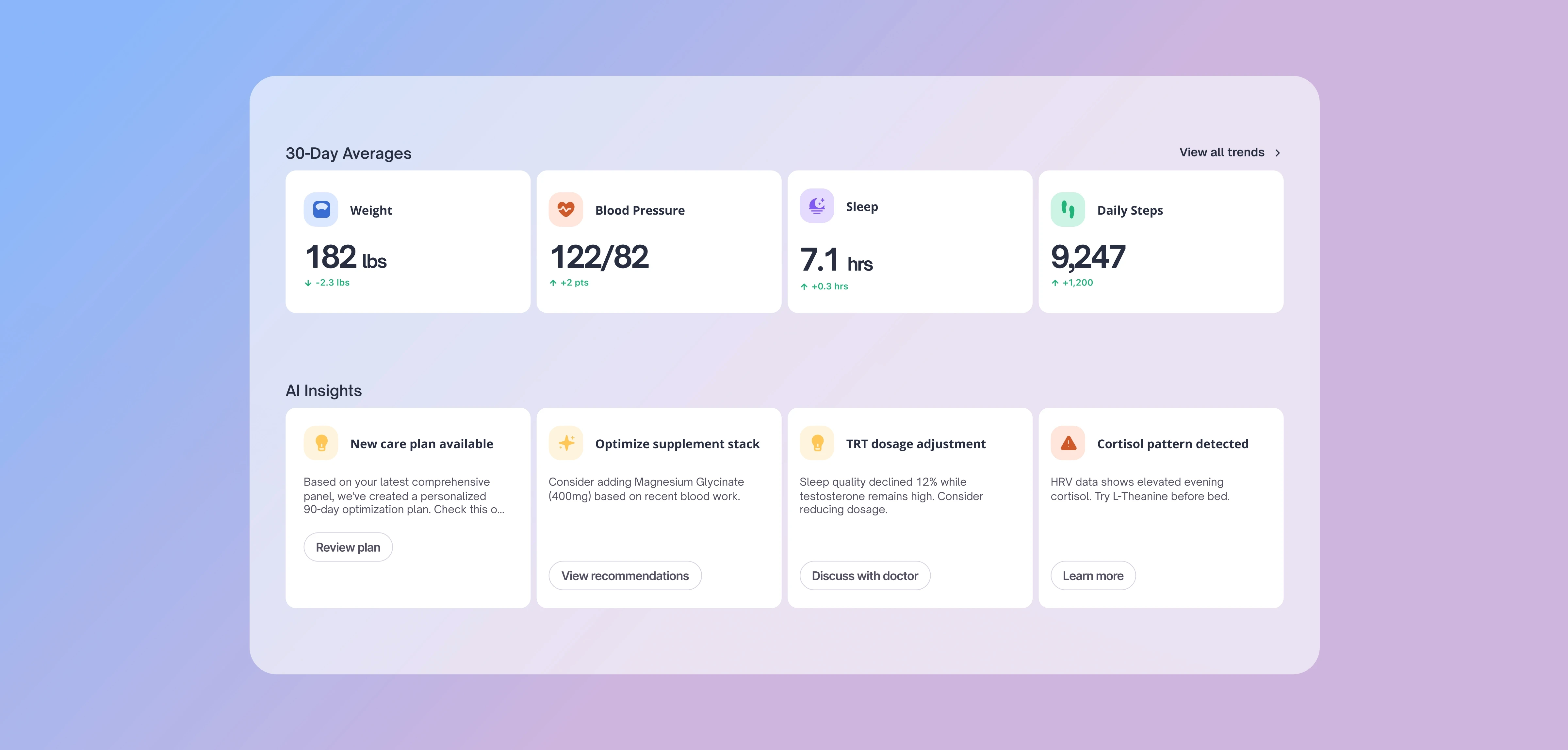
Every life stage brings new biological demands. Tracking the right metrics at the right time helps you adapt, optimize performance, and extend both lifespan and healthspan.
Your Annual Physical
Manual Data Processing
Guesswork Trend Detection
Once-a-year physical
Reactive, tested when sick
No data between visits
Once a year testing
Delayed Results
One-size dosing, set and forget
Real-Time Trend Insights
Daily smart-device data
Automated Data Sync
Quarterly Biomarker Tests
Optimal, personalized targets
Plain-language AI insights
Medications titrated to your data
Built to extend healthspan

Frequently Asked Questions
Clarity before
you commit
Answers on setup, scale, and support to remove blockers.